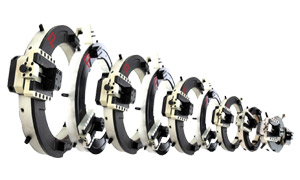
Weld failures in high-pressure piping rarely start at the weld itself. They start earlier, at the pipe end, in the few minutes it takes to cut a bevel. Get that geometry wrong and no amount of welder skill downstream will fully correct it. This is one reason procurement teams are paying closer attention to pipe bevelling machines before they ever reach the fabrication floor.
Why Bevel Accuracy Determines Joint Strength
ASME B31.3 provides guidance for preparing joints for most process piping in refineries, chemical facilities, and power plants. The V-grooves beveled within ASME B31.3 normally fall within the 30-45 degree range, while 37.5 degrees has become a standard setting for shielded metal arc welding in medium-wall pipes. The selected value is not random. In an 8 mm wall pipe, a 37.5-degree beveled joint creates a groove width of approximately 6 mm on each side, allowing the electrode to reach the root without excessive filler metal.
Even a slight deviation from the standard value requires the welder to compensate immediately by varying the travel speed or making extra welding passes. That compensation is not always visible on the surface. It shows up later, in radiographic film, or worse, in service, once the line is under pressure.
What to Check Before Buying
Not every bevelling machine performs the same way once wall thickness or material grade changes. A few things worth checking during evaluation:
- Does the angle setting hold across repeated cuts, or does it drift after the fifth or sixth pipe?
- Is the machine rated for the actual diameter and schedule range used on the project, not just a generic range in the brochure?
- Can it produce the bright, machined finish ASME B31.3 expects at butt weld ends, without secondary grinding?
- Will it hold tolerance on stainless steel and alloy pipe, where cutting behaviour differs from carbon steel?
- Can a two-person crew carry and set it up on a live site if the job calls for it?
A machine that fails on any of these points usually still cuts a bevel. It just doesn’t cut one that holds up under inspection.
Field Work Changes the Calculation
Tie-ins, hot taps, and repair work on live systems rarely allow pipe to be pulled and sent to a shop. This is why more contractors now choose to buy in-situ machining tools online: it lets bevelling, facing, and cold cutting happen at the joint itself, without taking the line out of service. It also removes the transport and crane work that shop-based prep would otherwise require.
Anyone planning to purchase in-situ machining tools online should ask suppliers for model-specific tolerance data, not general marketing figures, and confirm what support is available if the equipment needs servicing mid-project. Field conditions leave no room to troubleshoot on the fly.
Conclusion
Weld joint integrity in high-pressure piping is decided long before the first arc strike. It depends on a bevel that matches the joint design, the base material, and the welding process specified for the job. Fabricators who treat bevelling equipment selection as part of quality assurance, rather than a routine tooling purchase, see fewer rejections during radiographic examination and fewer failures after commissioning. As more projects shift toward in-situ preparation, the choice of machine directly affects whether a joint passes inspection the first time. For engineering teams sourcing equipment for critical piping work, Powermaster’s range of pipe preparation tools is built to support these tolerance and repeatability requirements across field and shop applications.